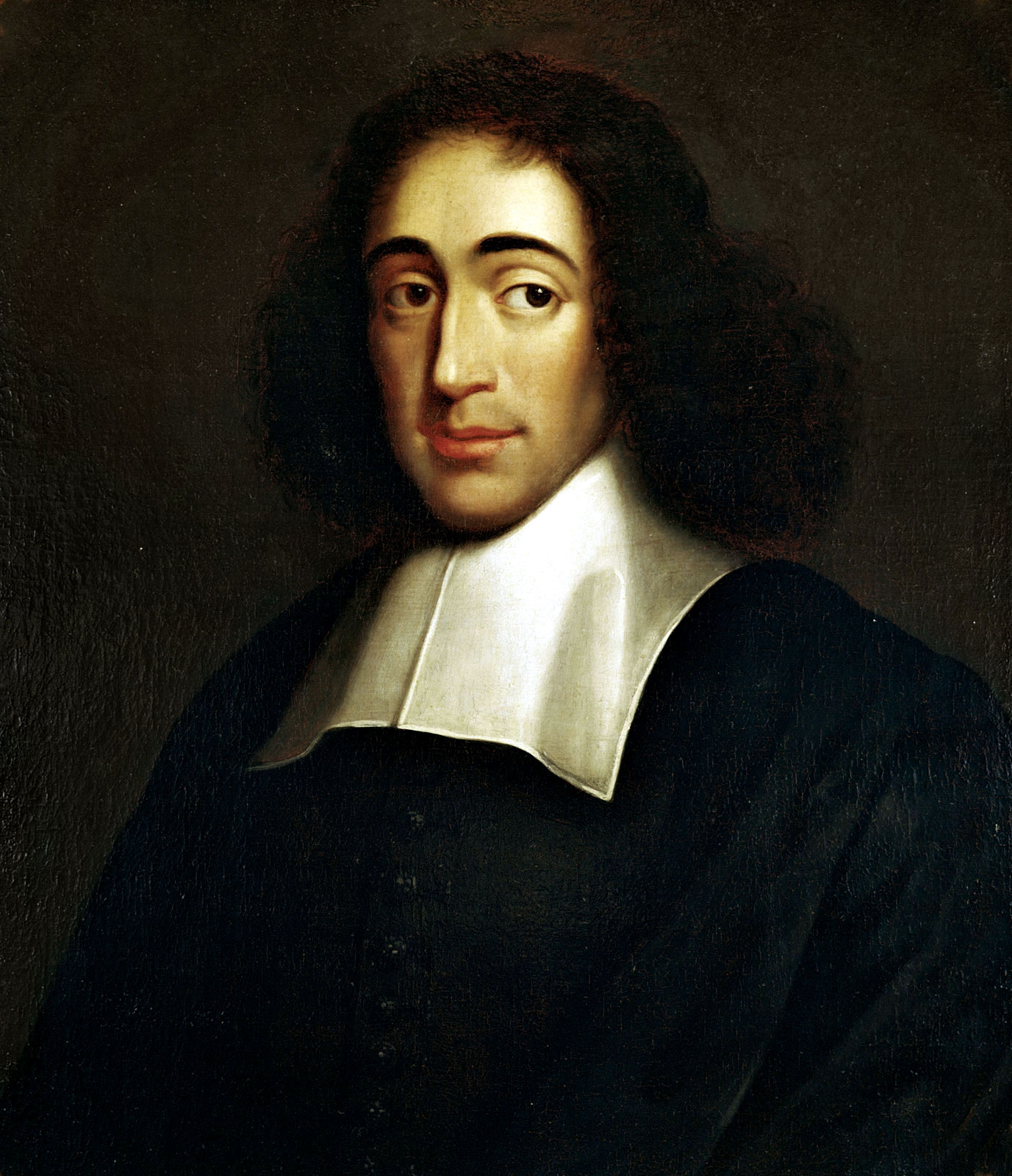
The Age of Enlightenment was a European cultural and intellectual movement whose aim was that society would move away from superstition and religious mantras and adopt reason and science as its foundation. Seven philosophers were associated with the initial process of the enlightenment, Bacon, Descartes, Hobbes, Spinoza, Locke, Bayle and Leibniz (Israel, J p.9).
However Spinoza's contribution was arguably the most crucial in crystallising what is termed Radical Enlightenment, primarily because his thought goes further than that of the other six in undermining belief in revelation, divine providence and miracles, and hence ecclesiastical authority, and also because he was the first major advocate of freedom of thought and the press as distinct from freedom of conscience, and the first great democratic philosopher (Israel, J p.10)The Ethics is a book in five parts. They are
- God, nature and the meaning of substance
- Nature of the mind
- Knowledge
- Passion and action
- Virtue and happiness
Now bear with me here, below is a summary of The Ethics taken from The Internet Encyclopaedia of Philosophy (a peer reviewed academic resource)
A monumental work that presents an ethical vision unfolding out of a monistic metaphysics in which God and Nature are identified. God is no longer the transcendent creator of the universe who rules it via providence, but Nature itself, understood as an infinite, necessary, and fully deterministic system of which humans are a part. Humans find happiness only through a rational understanding of this system and their place within it (Dutton, B, D 2005).As can be seen Spinoza had a very naturalistic view of God and of the Universe.
Spinoza rejects the traditional view of God and the world as separate from each other and the assumption of purpose, because the idea of somebody or something fulfilling a purpose implies the existence of a creator who is distinct from creation (Seidel, E 2001)One of the key arguments of Spinoza is that a human being should live by the guidance of reason alone and should not governed by fear or superstition. As Stephen Nadler again outlines in The Stanford Encyclopedia of Philosophy the crucial message of the work is:
.........in showing that our happiness and well-being lie not in a life enslaved to the passions and to the transitory goods we ordinarily pursue; nor in the related unreflective attachment to the superstitions that pass as religion, but rather in the life of reason (Nadler, S 2008).Spinoza was a Dutch Jewish philosopher. His ancestors were of Portugese descent. They were driven out of Portugal because of the Inquisition. In 1656 Spinoza was issued with a cherem, or excommunication, from his Jewish community in Amsterdam. It was life-long excommunication. The reason for this is not known but one can assume it was for his radical ideas and thinking. Like Montaigne before him his works were banned by the Catholic church and put on the Index Librorium Prohibitorum.
The Enlightened One Himself

This is a YouTube video of Spinoza's more famous quotes.
In the course of researching this blog I have come across a new term, a catablog and this is one concerning all things Spinoza.
As with "The Essays" above "The Ethics" is included in the book The 100 most influential books ever written by Martin Seymour-Smith
Notes on the research process
By and large I am enjoying the research process although I feel it is taking up too much time to the detriment of other subjects. One resource that I am finding particularly useful is to find one authoritive book on the subject and while it will not supply all required information it can deliver many good leads which can then be investigated. In Montaigne's case it was a book by Sarah Bakewell and in Spinoza's case it was a book by Jonathan Israel. Initially I am using Wikipedia and Britannica online and following on by using the Swinburne catalogue.Reference list
Age of Enlightenment - Wikipedia, the free encyclopedia, 2012, viewed 11 April 2012, <http://en.wikipedia.org/wiki/Age_of_Enlightenment>.
iPerspective 2011,Baruch Spinoza - Top 10 Quotes, 23 October, viewed 11 April 2012, <http://www.youtube.com/watch?feature=player_embedded&v=bbTTR9UI5fI>.
Dutton, B,D 2012, 'Spinoza, Benedict De' , Internet Encyclopedia of Philosophy, viewed 11 April 2012, <http://www.iep.utm.edu/spinoza/>.
Israel, J 2011, Democratic Enlightenment : Philosophy, Revolution, and Human Rights 1750-1790, e-book, viewed 11 April 2012, <http://swin.eblib.com.au.ezproxy.lib.swin.edu.au/patron/FullRecord.aspx?p=800816>.
Nadler, S 2012, Baruch Spinoza, viewed 11 April 2012, <http://plato.stanford.edu/entries/spinoza/>.
Necessarily Eternal, 2012, viewed 11 April 2012,
<http://perturbedintellect.typepad.com/necessarilyeternal/>.
Seidel, E 'SPINOZA.', European Judaism, vol. 34, no. 1
Spinoza 2012, [image] in Wikipedia Commons, viewed 11 April 2012, <http://upload.wikimedia.org/wikipedia/commons/e/ea/Spinoza.jpg>.
The 100 Most Influential Books Ever Written (book) - Wikipedia, the free encyclopedia, Public domain?, viewed 12 April 2012, <http://en.wikipedia.org/wiki/The_100_Most_Influential_Books_Ever_Written_(book)>.
The Project Gutenberg E-text of The Ethics, by Benedict de Spinoza, 2012, viewed 12 April 2012, <http://www.gutenberg.org/files/3800/3800-h/3800-h.htm>.